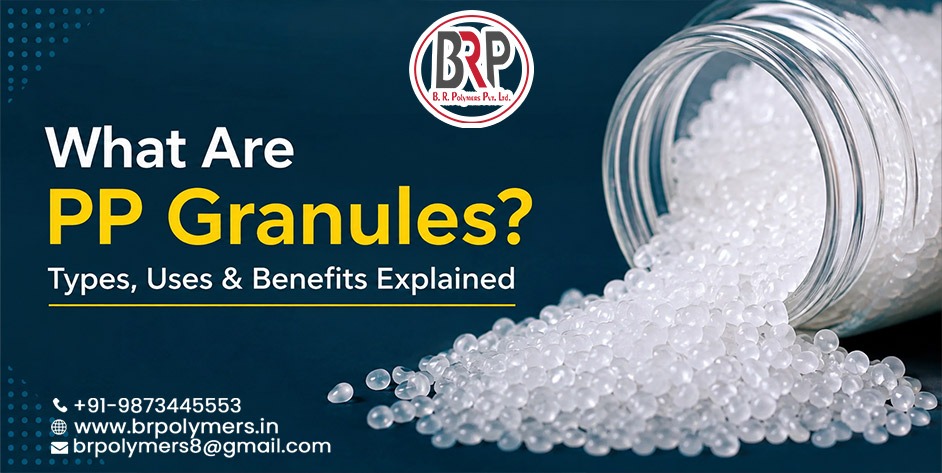
Versatile, durable and economical raw material is crucial to the modern plastics manufacturing industry for the production of everyday consumer products and increasingly complex industrial parts. Abbreviated as PP, polypropylene is one of the most commonly used thermoplastics in the world. These small pelletized polymer compounds are used as the basic raw material for injection molding, blow molding and extrusion processes, and are produced by leading PP Granules Manufacturers.
This blog describes PP granules, major kinds and a variety of industrial applications, and principle operational advantages.
PP Granules and the Role of Polymer Manufacturers
PP granules are tiny, uniform beads that are produced by the polymerization of propylene monomer gas. When temperature and pressure are controlled, and certain catalysts are added, the monomer units start to join together to form long molecular chains, yielding a tough thermoplastic resin. The liquid polymer is extruded into thin strands, cooled and cut into equal granules.
Reliable PP Granules Manufacturers pay strict attention to the chemical composition to make sure that each batch reaches the best Melt Flow Index (MFI), density, tensile strength and thermal stability. These granules are the raw material that is introduced into industrial processing equipment for melted processing and molding into industrial finished plastic products.
Primary Types of Polypropylene (PP) Granules
Polypropylene granules are produced in a variety of forms to address certain performance needs. The selection of the type to be used depends on the mechanical properties necessary for the end application.
A. PP Homopolymer
The most commonly used general purpose grade is PP homopolymer. It is made from 100% propylene units, and is a completely semi-crystalline continuous polymer.
- Key Features: High strength to weight ratio, excellent stiffness and a good chemical resistance
- Common Applications: Packaging Containers, Housewares, Textiles, Rigid Parts
B. PP Copolymer
Polymerization of propylene with a small amount of ethylene is used to produce copolymers to alter the physical properties.
- Block Copolymer: Block copolymer, which has the co-monomer units grouped in the separate block segments. It offers high impact resistance at lower temperatures, making it suitable for used in heavy duty containers and the vehicles bumpers.
- Random Copolymer: Contains randomly distributed ethylene units on its polymer chain. This provides more transparency, clarity and flexibility and is preferred for clear storage boxes and medical supplies.
C. Recycled and Modified PP Granules
Reprocessed PP granules are the granules obtained by collecting post-industrial or post-consumer plastic waste, sorting and re-extruding it into granules that can be used. Glass fibre or mineral fillers can also be added to reinforced grades to provide added stiffness and dimensional stability.
Major Benefits of Using Polypropylene Granules
The advantages of using PP granules in manufacturing processes are evident and clearly financial and operational:
- Superior Cost-Efficiency: Polypropylene has also an economical balance between price and performance as compared to engineering plastics.
- Moisture & Chemical Barrier: It is non-porous and will not allow chemicals to be absorbed.
- High Stress and Fatigue Resistance: Continuous movement or pressure will not cause changes in the material's mechanical properties.
- Environmental Sustainability: PP is 100% recyclable, benefiting the businesses in their efforts to minimize the landfill waste.
Final Thoughts
From manufacturing and packaging to industrial applications, these polypropylene granules are needed components, providing the strength, flexibility and cost effectiveness needed in the various industries. Collaborating with reputed PP Granules Manufacturers such as B.R. Polymers provides access to the resin grades of the high purity, designed for the most precise manufacturing demands.
FAQs
Can PP be recycled?
Yes, polypropylene granules can be easily recycled multiple times.
What is the melting point of PP granules?
Polypropylene granules usually melt at temperature of 130-171 degrees Celsius.
Is PP plastic food safe?
Yes, polypropylene is considered to be food grade, safe and non-toxic for food container uses.
How is PP converted to a product?
They are manufactured by injection molding, blow molding, extrusion or thermoforming processes.